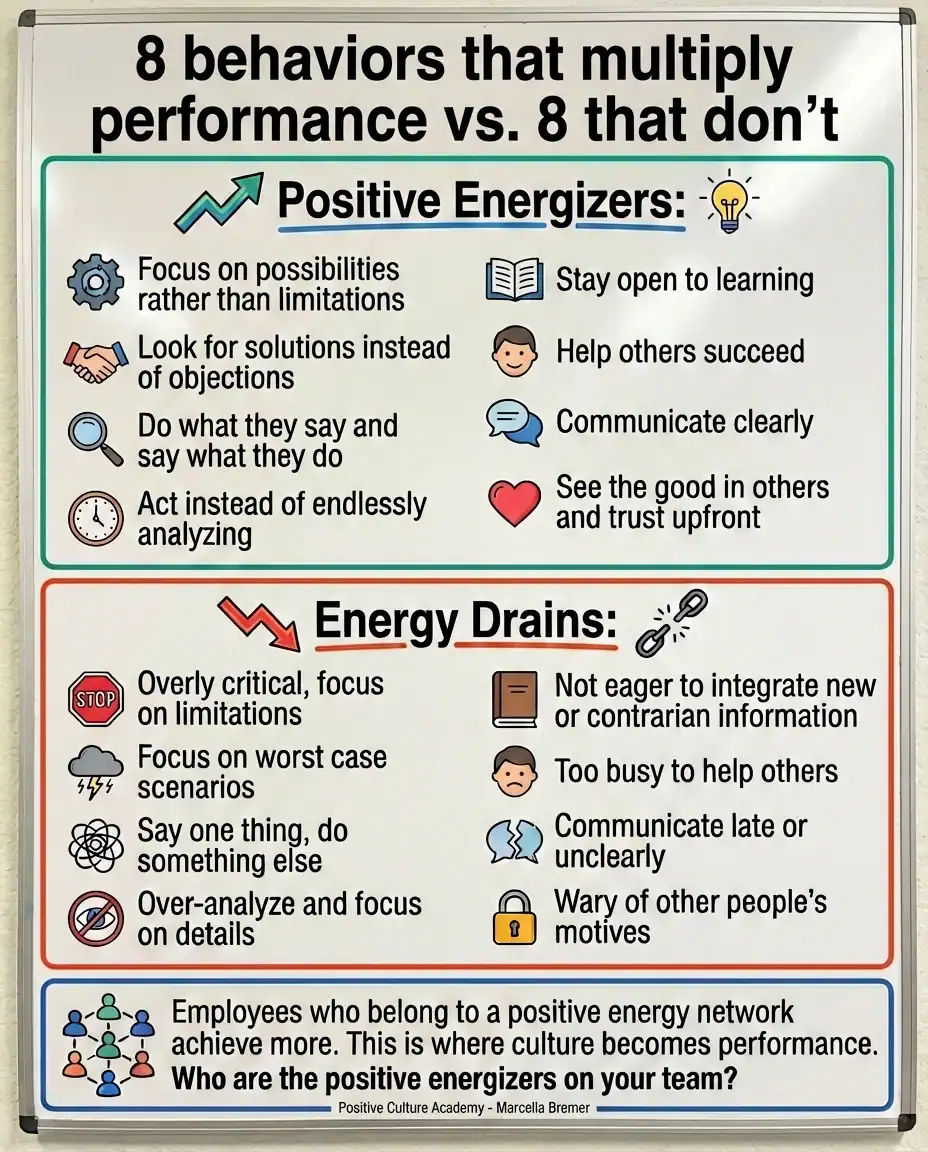
Some people multiply performance. Others weaken it. Most leaders underestimate which group they’re in.
Researchers Baker, Cross, and Wooten describe people who act as energizers or energy drains. Not personality types. Behavioral patterns. These are learned behaviors, so let’s create positive, high-performing teams.
What energizers do differently
Energizers stimulate vitality in others. After interacting with them, colleagues feel more motivated and capable. Energy drains do the opposite. They reduce enthusiasm and leave others tired.
This isn’t about being extroverted or charismatic. It’s about learned behavior.
Positive energizers tend to be focused on possibilities rather than limitations, solution-oriented rather than objection-driven. They are reliable (they do what they say) and clear communicators who trust others by default.
They are optimistic, attentive, and unselfish. People are drawn to them.
Energy-draining behavior looks different: critical, inflexible, self-focused, unreliable. Over time, these patterns weaken collaboration and reduce performance across a team.
Optimize the human operating system
Here’s what makes this more than a “nice to have.”
Employee success is predicted more reliably by belonging to a positive energy network than by their position in the information network or the hierarchy.
That research finding deserves a second read. It means the people who energize others aren’t just pleasant to work with. They’re performance multipliers. Their impact spreads through trust, coordination, and collaboration, not through authority or access to information.
As one reader put it: energizers aren’t just personality types, they’re system nodes. The way they show up changes the output of everyone around them. That’s not just culture. That’s network architecture in human form.
Objections can be useful, but behavior is what matters
One important nuance. Being solution-oriented doesn’t mean ignoring problems. Objections often contain useful information. The difference is what you do with them. If you use objections to resist everything, it becomes energy-draining behavior. If you use them to improve the work, that’s a different story entirely.
The distinction isn’t between positive and critical. It’s between constructive and corrosive.
How to find the energizers
You probably already know who they are. But here’s a simple way to make it visible.
Ask people to name two or three colleagues who leave them feeling more motivated after an interaction. The same names will come up again and again.
Those people are your multipliers.
Include and engage them wisely
The more interactions energizers have, the more their colleagues benefit. So include them in meetings, project groups, and brainstorm sessions. Give them influence where ideas are shaped and decisions are made.
But there’s a risk. Energizers can get overloaded precisely because they’re the ones everyone turns to. It’s easier for management to give them more work than to address the energy drains. Over time, that can wear them down.
The balance matters. Energizers tend to communicate clearly about their capacity and boundaries. But leaders should watch for the pattern and protect their energizers, not exploit them.
The behaviors can be learned
The most important insight from the research: these are learned behaviors and thinking patterns. They can be developed.
That means this isn’t just about identifying who your energizers are. It’s about helping more people develop these patterns and creating a culture where energizing behavior becomes the norm rather than the exception.
I share more tools for developing a positive, productive, future-fit culture in the Positive Culture Academy.
© Marcella Bremer, 2026