There is a kind of strategic failure that never announces itself. The team is capable. The plan is well-reasoned. Execution has been solid. And yet, something seems off….
Not because the strategy is badly designed. Because it was designed for a world that is changing.
This is how most strategies fail. Not through poor execution, but through assumptions that are never named, never questioned, and never updated. The plan keeps running on beliefs that have stopped being true.
The belief underneath the plan
Think about a regional logistics company that built its entire model around next-day delivery as a premium differentiator. For years, that assumption held. Customers would pay more for speed. Competitors couldn’t match it. The margin was reliable.
Then Amazon normalized same-day delivery. Then, customers stopped thinking of next-day as premium and started thinking of it as basic. The logistics company’s strategy didn’t change, because nobody named “customers will pay a premium for next-day speed” as an assumption. It was just how things worked. Familiar. Unquestioned.
By the time the margin erosion showed up clearly in the numbers, the window for a low-cost course correction had closed.
That’s the risk with unexamined assumptions. They don’t announce when they stop being true. They just erode the foundation your strategy is built on.
Why leadership teams don’t catch this
Surfacing assumptions sounds straightforward. Just ask: what are we assuming? But in practice, most leadership teams find it surprisingly hard for a few reasons.
The most load-bearing assumptions are often the most invisible. Beliefs that have been true for a long time stop feeling like beliefs. They feel like facts.
- “Our customers value relationships over price.”
- “Our reputation in this market is a durable advantage.”
- “Margins in this category are stable.”
Nobody wrote those down as assumptions. They were just true.
Until they weren’t.
There’s also a culture dimension. Most leadership teams, under operational pressure, reward decisiveness.
Questioning a core assumption can feel like undermining the direction you’ve set, or opening a conversation nobody has time for. So the question doesn’t get asked. The assumption stays in place. The strategy keeps running.
In an AI-accelerated world, where the pace of change in customer expectations, competitive dynamics, and business models has genuinely accelerated, the cost of that avoidance is rising.
A five-minute exercise worth doing this week
You don’t need a strategy retreat to start working on this. You need twenty minutes and a willingness to be honest.
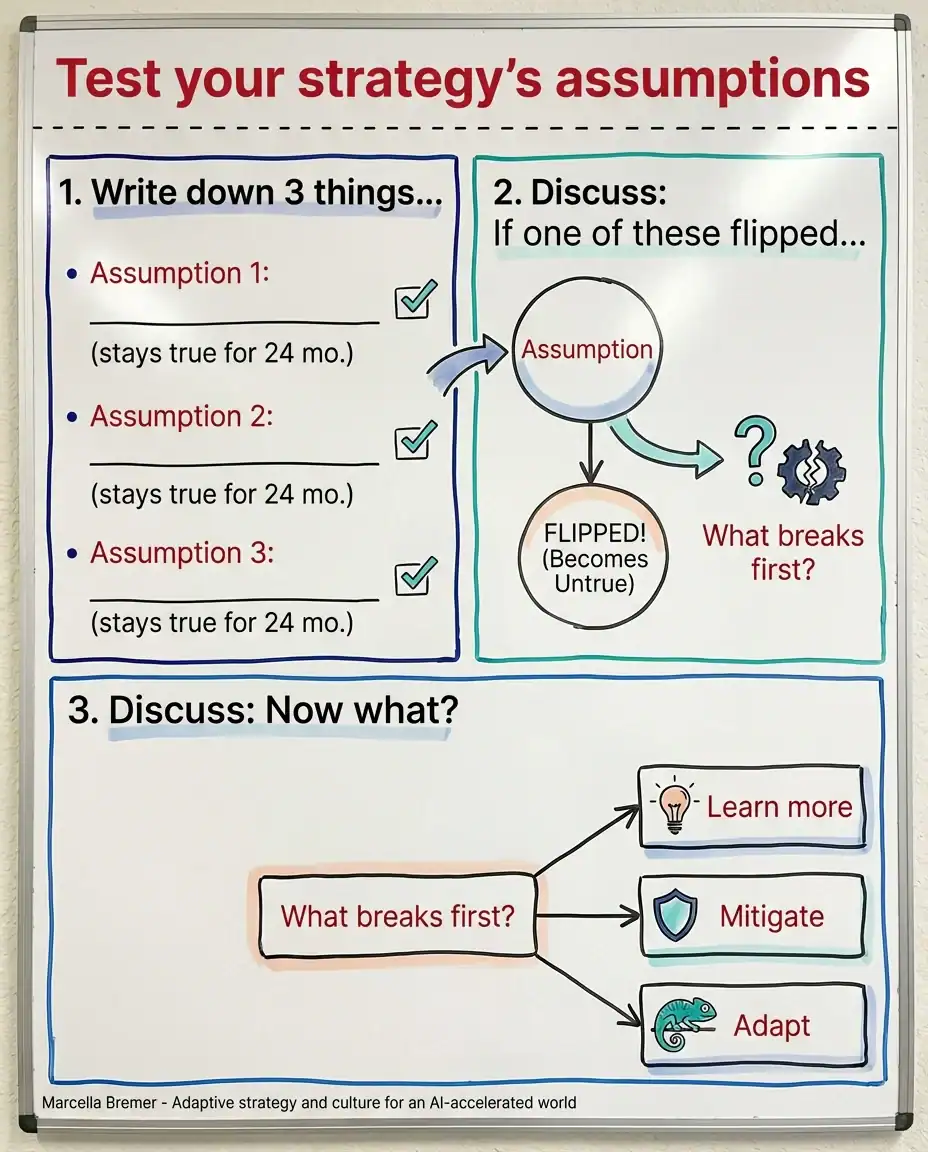
1. Start with one question: What does your current strategy assume will stay true for the next 24 months?
Write down three answers. Not the strategy itself, but the beliefs underneath it. Examples might include:
- “Our core customer segment will keep buying through the same channel.”
- Or: “Our labor costs will remain predictable enough to plan around.”
- Or: “AI won’t materially change what customers expect from us in the next two years.”
2. Once you have three, ask a harder question: If one of these flips tomorrow, what breaks first?
Don’t ask what would be inconvenient. What would actually break? Which part of your business model depends most on that assumption holding?
3. Then the most important question: Now what? Would you need to learn more before acting? Mitigate the risk now? Adapt the strategy proactively?
This sequence is the core of what an adaptive strategy looks like in practice. It doesn’t require a framework. It requires honesty and a structured conversation.
The companies that adapt fastest
Here is what separates organizations that navigate change well from those that get blindsided by it. It is rarely resources or intelligence. It is whether the leadership team has built the habit of questioning what they’re assuming.
The companies that adapt fastest are not the ones with the best forecasts. Forecasting in an uncertain environment is unreliable by definition. They are the ones who revisit their assumptions more often. Who ask, regularly and seriously: is this still true? What’s changed? What does that mean for how we’re operating?
That habit doesn’t require a full strategy overhaul every quarter. It requires a standing question in your leadership conversations, and the willingness to act when the answer changes.
If you’re building for 2026 and beyond, you can’t afford to operate on 2023 logic. The pace of change in AI alone has made assumptions that were reasonable three years ago genuinely fragile today, in every industry, at every size.
Start with one assumption
You don’t need to audit every assumption in your strategy today. Start with one.
What is one belief your strategy currently depends on that feels overdue for scrutiny?
That’s the one to look at first. Ask what would break if it flipped. Decide what you’d do.
This conversation with your team is more strategically valuable than most quarterly reviews.
© Marcella Bremer, 2026
If you want us to facilitate your team, consider the 2-hour Adaptive Strategy Sprint.
If you want to work on your own, we’ve created a short Future-Fit Diagnostic to help assess your adaptive capacity.
You can download it here ↓