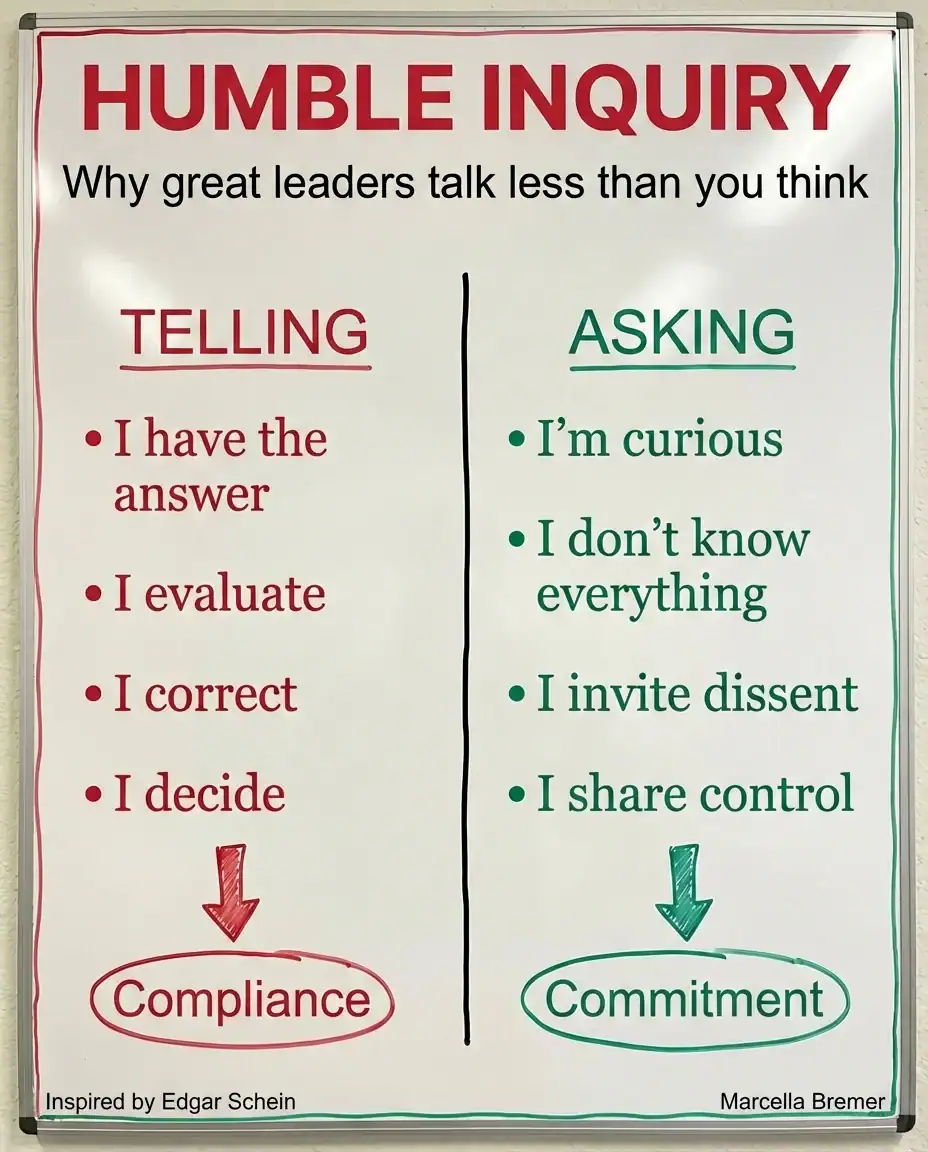
Do you often know the answer, and do you share that with your team? If you’re a leader, that might be a dangerous habit.
Think about how most leadership promotions work. You promote the best engineer. The best salesperson. The best performer.
Next, these leaders keep solving. They keep telling and become the smartest person in the room.
It works for a while. Then it stops working, and the leader rarely sees why.
What you miss when you keep talking
When a leader always has the answers, something happens in the room. People stop raising concerns and start filtering what they share based on what they think the leader wants to hear. They don’t question assumptions, they don’t share doubts, there’s no real learning and reflection, as the leader always tells them: “This is how it is. This is the solution.”
The team is trained to wait for answers and to stop sharing their own thinking.
The leader experiences this as a smoothly functioning team. What it is, in practice, is an information blackout.
The alternative is “Humble Inquiry,” the art of asking questions you genuinely don’t know the answer to – as described by organizational psychologist Edgar Schein.
His core insight: in complex organizations, the person with the title (a.k.a. the leader) often has less relevant information than the person doing the job. The leader depends on the team more than the team depends on the leader. If people don’t feel safe speaking up, you’re not leading. You’re operating blind.
The ask-to-tell ratio
Most leaders, if they tracked it honestly, would find their ask-to-tell ratio heavily weighted toward telling. This isn’t a character flaw. It’s a habit reinforced by every promotion system that rewards having answers.
But telling creates distance. Asking builds connection and trust.
The shift isn’t complicated to understand. However, it can be hard to practice because it requires suspending the instinct to solve and replacing it with the discipline to listen.
Consider the difference between these two questions in a leadership conversation:
“This reorganization will improve collaboration, right?” versus “What could make this reorganization fail?”
The first implies a conclusion and invites agreement. The second invites ownership. It gives people permission to surface the uncomfortable truth, which is exactly the information a leader needs most.
Four questions worth replacing
Here are four common leadership situations where the default question closes down thinking, while the better question opens it up.
1. On strategy: instead of “Don’t you think we should double down on this market?” ask:
“What risks are we not seeing in this strategy?” The first leads the witness. The second invites dissent.
2. On change initiatives: instead of “This reorganization will improve collaboration, right?” ask:
“What could make this reorganization fail?” The first seeks validation. The second surfaces the real obstacles.
3. On pace and innovation: instead of “Why aren’t we moving faster on this?” ask:
“What’s making this harder than we expected?” The first signals pressure. The second signals curiosity, and people respond to it very differently.
4. On customer focus: instead of “We need to be more customer-centric,” ask:
“Where are we unintentionally making it hard for customers?” The first demands compliance. The second drives ownership.
In each case, the better question does two things. It produces better information. And it signals to the team that their perspective is genuinely wanted, not just tolerated.
Why this matters more than before
In an AI-accelerated world, the signals that matter are often at the edges of the organization. The frontline employee who notices a change in customer behavior. The engineer who sees a competitor doing something differently. The sales rep who hears a new objection that doesn’t fit the current pitch.
No leader can see all of that. No individual at the top of an organization has the full picture anymore. The only way to navigate genuine uncertainty is to tap into the collective intelligence of the people around you.
That requires psychological safety. And psychological safety is built, one conversation at a time, by leaders who ask questions they don’t already know the answer to.
Asking more questions is not a soft leadership skill. It is a strategic capability. It is how you keep the information flowing in an organization that needs to adapt.
Try one question this week
You don’t need to overhaul your leadership style to start. Pick one conversation this week where you would normally tell, and ask instead.
Not a question that leads somewhere you’ve already decided. A genuine question.
- “What am I missing here?”
- “What would make this fail?”
- “What’s making this harder than we expected?”
Then listen without filling the silence.
When was the last time you asked a question you didn’t know the answer to?
© Marcella Bremer, 2026
If this tension feels familiar inside your leadership team, we’ve created a short Future-Fit Diagnostic to help assess your adaptive capacity.
You can download it here ↓