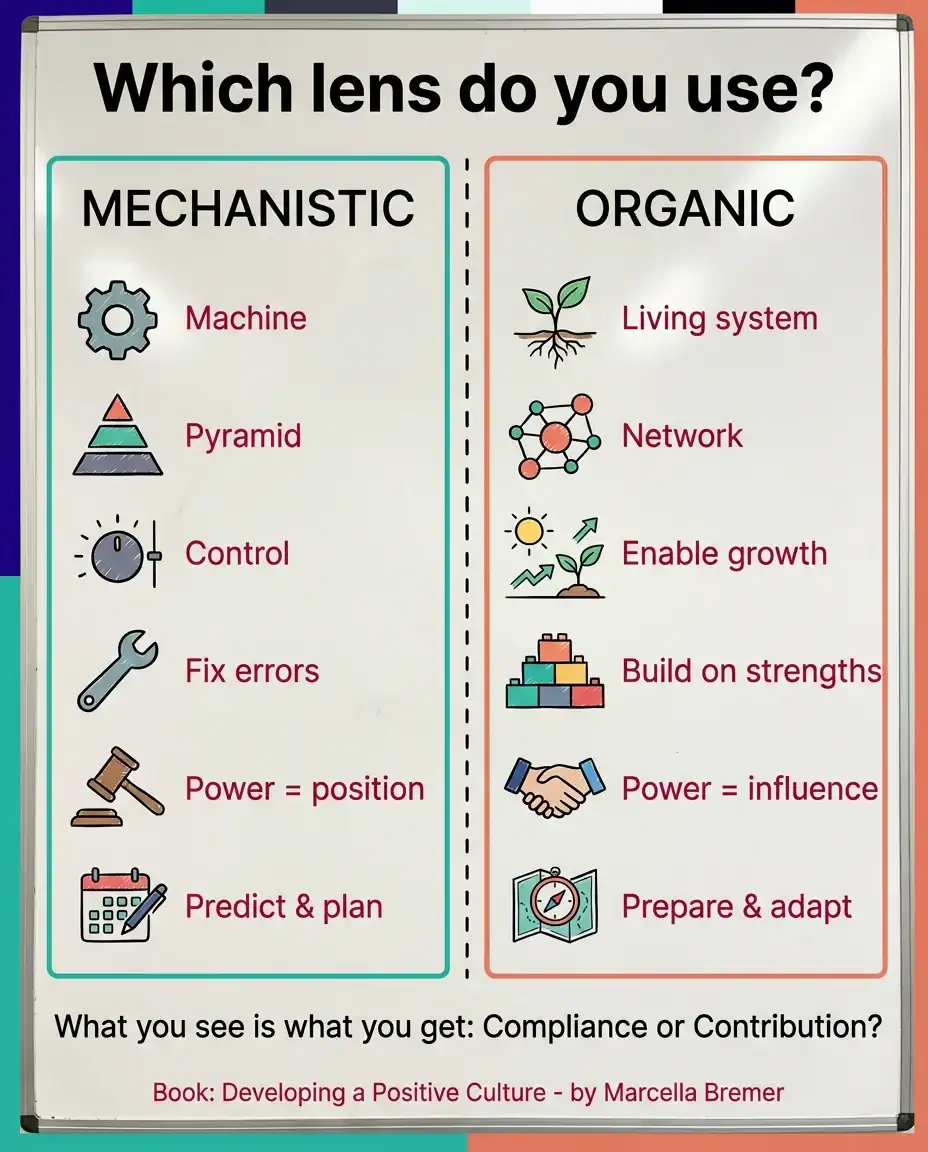
Most leadership problems aren’t behavior problems. They’re mindset problems. Because what you see is what you get.
There are two lenses to see an organization.
The traditional mechanistic mindset treats the organization as a machine: hierarchy, control, leaders as engineers fixing errors, and power based on position.
The emerging organic mindset treats it as a living system: network, shared purpose, leaders as gardeners enabling growth, power based on influence.
Both can be useful. But if you solely apply a machine mindset to a living system, you create friction. If you treat educated professionals like programmable parts, you get compliance. By contrast, if you treat them as contributors in a network, you get commitment.
If you cling to the mechanistic mindset alone, your organization scores lower on adaptability. In the fast-changing circumstances and uncertainties of our current and future VUCA world, the organic mindset is indispensable.
The gap between saying and doing
Often, leaders genuinely believe they’re operating with an organic mindset. The company values are on the wall: “learning, agility, innovation”. The language is collaborative. But when you look at the internal systems, the meeting structures, the decision-making processes, and their stress responses, everything is mechanistic.
This creates a mismatch between the external image and the internal reality. Bridging that gap requires self-awareness from leadership and a good deal of courage to acknowledge it.
When I posted this on LinkedIn, I got a lot of responses. As one reader put it: “Mechanistic leadership is anxiety with a title.” That line stings because it’s often accurate. When leaders feel uncertain, the instinct is to tighten control. But control is a machine response to a living-system problem.
A machine lens produces a tight hierarchy, low autonomy, and narrow feedback loops. Over time, even an organization that started as a living system will behave like a machine if the structural constraints stay mechanical. The mindset gets baked into the structure, the processes, and the criteria: how to deal with variety, autonomy, and control. Organizational culture follows the dominant mindset.
What living systems do
If we use the organic lens, we can benefit from the principles of living systems.
Living systems self-organize. Permission is a bottleneck. When you let teams adapt locally, you get faster, smarter responses.
Living systems interconnect. Silos starve the body. Shared signals and shared information keep the organizational system healthy.
And living systems need diversity. Uniformity is fragile. Different options can evolve into new opportunities or better ways of working.
These aren’t abstract ideals. They’re practical design choices. How much autonomy do your teams have? How freely does information flow across departments? How much genuine diversity of thought is welcomed in decision-making?
The lens you use determines organizational adaptability, and that is vital in an AI-accelerated world.
What you see is what you get
Leaders often try to fix employee behavior that emerges from the dominant mindset, which shapes structure, processes, criteria, and culture.
If you believe the organization is a machine, you optimize for control, reporting lines, and tighter oversight. A team leader commented, “When organizations are treated like machines, people adapt by doing the minimum.”
An executive coach added: “What I see in fast-moving tech orgs is that the machine mindset usually survives longest in the middle. Middle managers inherited control-based habits from above and are accidentally recreating the same friction they complained about on the way up.”
If you believe it’s a living system, you pay attention to feedback loops, incentives, and how decisions ripple through the network. As someone noticed: “When leaders truly see their teams as contributors in a network, the commitment and ingenuity unlocked are incredible. It moves beyond compliance to true engagement and shared ownership.”
Choose your lens wisely
The question is which lens you’re using.
When you look at your organization through an organic lens, what changes? What would you stop controlling? What would you start enabling?
In the age of AI, this matters more than ever. Acceleration and interconnected challenges demand adaptive, networked responses. A machine mindset optimizes for a world that is stable. A living-system mindset prepares you for one that isn’t.
I have a longer list of assumptions, behaviors, and consequences of the mechanistic and organic mindset in my book Developing a Positive Culture.
We often use a blend of both mindsets.
Being aware of the lenses helps you apply both/and thinking. Choosing your lens for a problem amplifies the number of interventions you see.
- What do you see through the mechanistic lens, and how would you solve certain issues?
- What changes when you look through the organic lens?
The lens you use determines organizational adaptability, and that is vital in an AI-accelerated world.
© Marcella Bremer, 2026
If you want to check how adaptive your company is, we’ve created a short Future-Fit Diagnostic to help assess your adaptive capacity. Download it here ↓ https://mlla.nl/futurefit