Decision-making is hard with multiple known and unknown factors at play. We have to deal with it: companies and individuals face more uncertainty in this accelerating age, and it’s not going away.
Maybe you respond with endless analysis or premature commitment. Most leadership teams default to one of the two when facing uncertainty.
Both look like action. Neither is.
Endless analysis is running in circles around a single prediction. Premature commitment is handcuffing yourself to one option. One delays tension. The other suppresses it. But both are forms of avoidance.
One simple practice that helps
One practice has consistently helped the teams I work with improve decisions, without needing certainty.
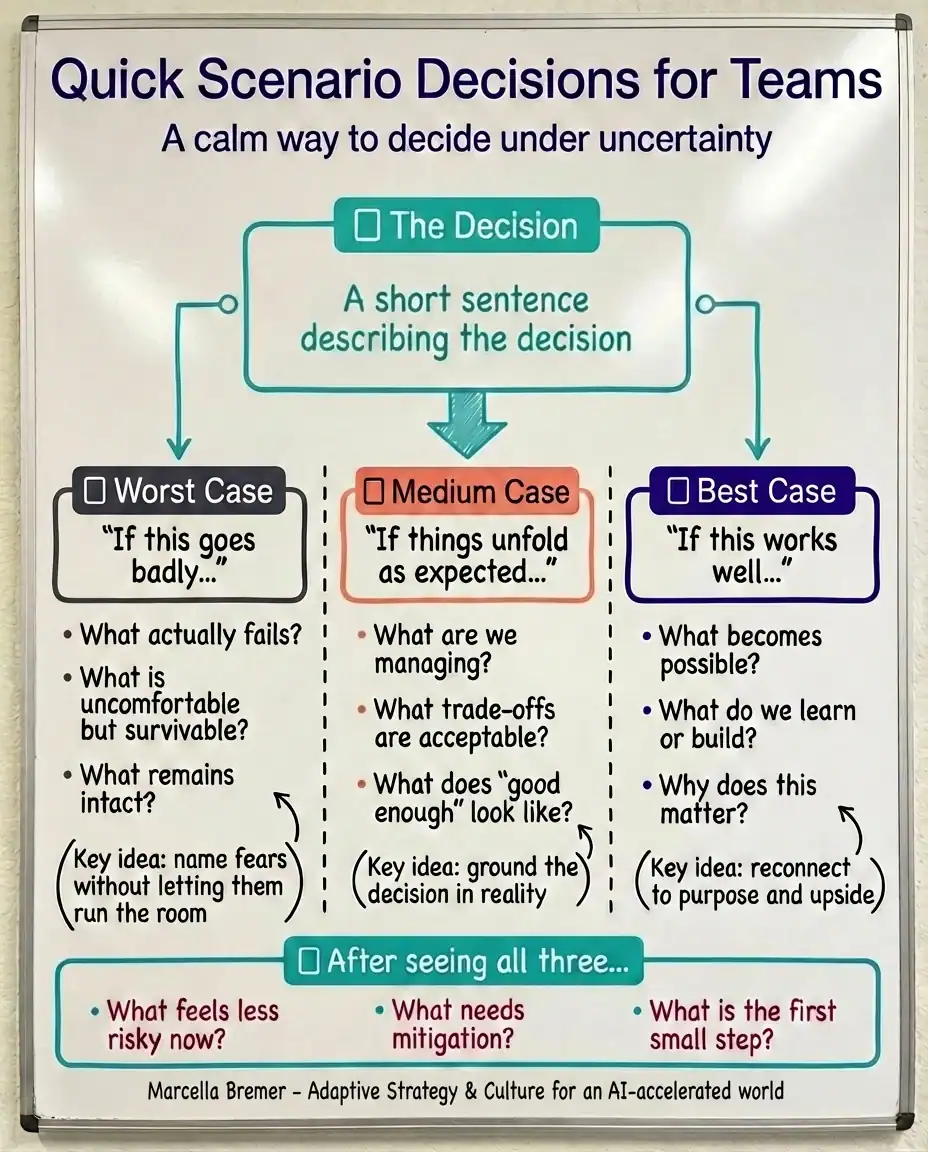
Before committing to a decision, map three possible scenarios together. Not detailed forecasts. Not spreadsheets. Just a short, structured conversation.
We look at three scenarios:
- Worst case: if this doesn’t work, what does that look like?
- Medium case: if things unfold as expected, what are we dealing with?
- Best case: if this works well, what becomes possible?
What matters isn’t predicting the future. It’s making assumptions visible.
Most leadership teams are making decisions around unspoken fears and untested hopes. This exercise brings both to the surface.
Why this works so well
In smaller organizations, decisions often carry more weight. There’s less margin for error, fewer fallback options, and the consequences land faster. That makes it tempting to either over-analyze or just pick something and move.
This scenario check does several important things. It surfaces risks that are often felt but not spoken. It tempers unrealistic optimism without feeding fear. And it creates a shared picture, instead of fragmented individual worries.
Most of the time, the worst case turns out to be uncomfortable but survivable.
The medium case is manageable with preparation.
The best case clarifies why the decision is worth engaging with at all.
That realization alone (that the worst case is survivable) often restores the calm needed to decide well.
Making it safe
The real value isn’t the scenarios themselves. It’s that the conversation forces a team to say out loud what they’re individually afraid of. Because that’s where alignment often breaks down: around things people are thinking but not saying.
But for this practice to work, the team has to feel safe. If people filter their answers, you’re just getting polished versions.
One approach I use when facilitating: I ask people to write their three scenarios on separate post-its, without names, and paste them onto a whiteboard.
You can also frame it to open up thinking: let’s use our imagination and go overboard. Create an extreme best, medium, and worst case to stretch our thinking. This framing gives people permission to say what they think, because it’s presented as imagination, not prediction.
When a team articulates worst, medium, and best cases together, they’re not trying to see the future. They’re recalibrating. They’re loosening the grip of “one story” while they get space to consider three stories in parallel. That shared exchange improves their collaboration and their decisions.
This works for personal decisions, too
Of course, you don’t need a leadership team to use this. The same three questions work for private decisions: a career move, a financial commitment, a life change.
Write down the worst, medium, and best cases. Just a few lines each. What you’ll usually find is that the worst case is less catastrophic than it felt in your head, and the best case is more motivating than you expected.
It doesn’t tell you what to do. But it replaces the loop of anxiety with something structured. And that’s often enough to move forward.
Simple practices for uncertain times
This quick check has informed several recent decisions for our own small team. Not by telling us what to do, but by restoring calm, shared judgment, and agency. In times of continuous change, resilient leadership isn’t about eliminating uncertainty. It’s about creating simple practices that help people think clearly, together or alone.
© Marcella Bremer, 2026
If decision-making is hard for your leadership team, we’ve created a short Future-Fit Diagnostic to help assess your adaptive capacity. Download it here ↓ https://mlla.nl/futurefit
If you want to check if your strategy is adapted to possible future scenarios, check out our Strategy Sprint for leadership teams at https://www.marcellabremer.com/strategy/