In your last team meeting, what did you almost say, but didn’t?
That hesitation is information.
Most teams think they have alignment. What they often have is silence. And silence is not agreement. It’s a signal that something in the culture makes honesty feel too expensive.
Safe cultures welcome disagreement
Psychological safety isn’t about everyone speaking constantly. It means that disagreement doesn’t feel scary and career-limiting. It means that questions, doubts, and new ideas are welcomed and explored rather than suppressed or punished.
Amy Edmondson’s research is clear on this: staying silent yields immediate rewards for the individual. You don’t rock the boat; you stay safe. While the rewards of speaking up are uncertain, they are in the future. That asymmetry means most people choose silence, unless the culture makes speaking up feel safer than holding back.
The cost of that silence is enormous. Lost learning, missed opportunities, eroding trust, stalled innovation, weaker performance. Teams that don’t hear all voices become biased and blindsided. It’s a matter of time.
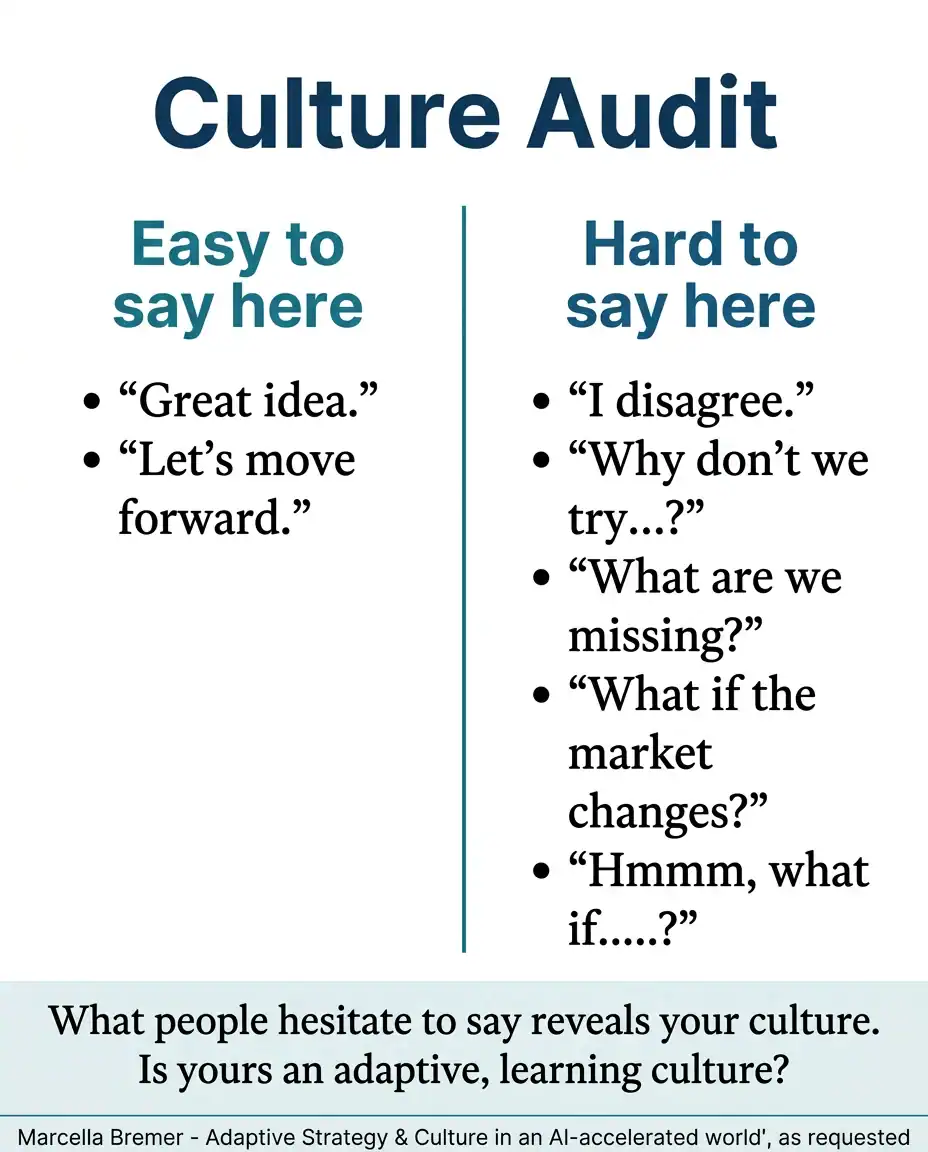
Quick culture audit
Here’s a simple exercise you can use with your leadership team. Create two columns:
Easy to say here | Hard to say here
Then fill them in. Honestly.
If your “Hard to say” column includes sentences like “This won’t work” or “I disagree with the direction,” you don’t have alignment. You have compliance.
If it includes “I doubt if…” or “Why don’t we try…?” or “Have you considered…?”, your team is not improving plans or exploring new ideas. You’re optimizing in a bubble.
If it includes “What if AI disrupts our market?” or “What if our customers change faster than we expect?”, you’re not looking at possible future scenarios. You’re steering with your eyes closed.
When we stay silent, we often tell ourselves we’re just being polite. But that silence is usually a calculation of the social cost of being honest. And when everyone makes that calculation at the same time, your meetings feel productive while the real issues stay underground.
Make the exercise safe enough
When I posted this exercise on LinkedIn, it elicited a lot of responses.
The value of this audit depends on how safe it feels to be honest. If your team members filter their answers, you’re just collecting polished performances. You don’t need pretend rituals. You need genuine responses.
One reader suggested using this in a workshop where the team completes it together and then identifies concrete ways of working to improve safety.
That works well when the baseline trust is there. If the team feels super unsafe and people are frightened, you may need to start with anonymized input first to get things on the table. Ask people to write their responses on paper and collect them in a hat. Next, share their collective answers with the group. However, this is an extreme example. I’ve done this only twice in 25 years. It’s a last resort, but it created enough momentum to start real conversations.
Often, it’s not that bad. So, how can you make the audit safe enough to be insightful and valuable?
If there’s a baseline level of safety, draw the columns on a flip chart and ask everyone to write sentences on post-it notes and paste them in the columns. No names needed. Discussing what’s on the whiteboard feels less personal and scary than every team member reading their sentences to the room.
You can also ask people to complete the exercise in pairs first, so no single individual feels exposed. Then ask the pairs to find another pair and combine their input. Next, this small pod of four can share their joint findings with the group.
If you’re a leader, go first and share openly; that helps set the tone. But be aware: leaders often experience the culture differently. What feels easy to say for the person in charge may feel risky for the rest of the team.
Adaptive companies are safe
Adaptive, future-fit organizations need to keep learning and adjusting to whatever happens or might happen. That requires teams where all perspectives are explored, where doubts are voiced, and where new ideas get a fair hearing.
If the most important sentence in your meeting is the one nobody says, your team is not learning. And a team that isn’t learning is falling behind.
Save this exercise and test it in your next meeting.
- What’s one topic that still feels risky to raise in your company?
- How can you make it safer? (Tip: read my earlier article on social safety about Edmondson’s book).
© Marcella Bremer, 2026