Many companies know they need to become more adaptive in our complex, unpredictable, AI-accelerated world. But very few run experiments.
Big restructuring or change programs might not be necessary. Thorough research and analysis don’t work anymore. That worked well when industries, markets, supply chains, and customers (and any other system) were more stable.
In today’s complex world, you need small, safe tests that create real learning. Because adaptation doesn’t come from better plans, it comes from faster learning loops.
When I posted these six simple experiments on LinkedIn, one comment captured why this matters: “A big transformation raises fear and posturing. A contained test gives people something concrete to see, discuss, and improve. That is how trust builds under pressure.”
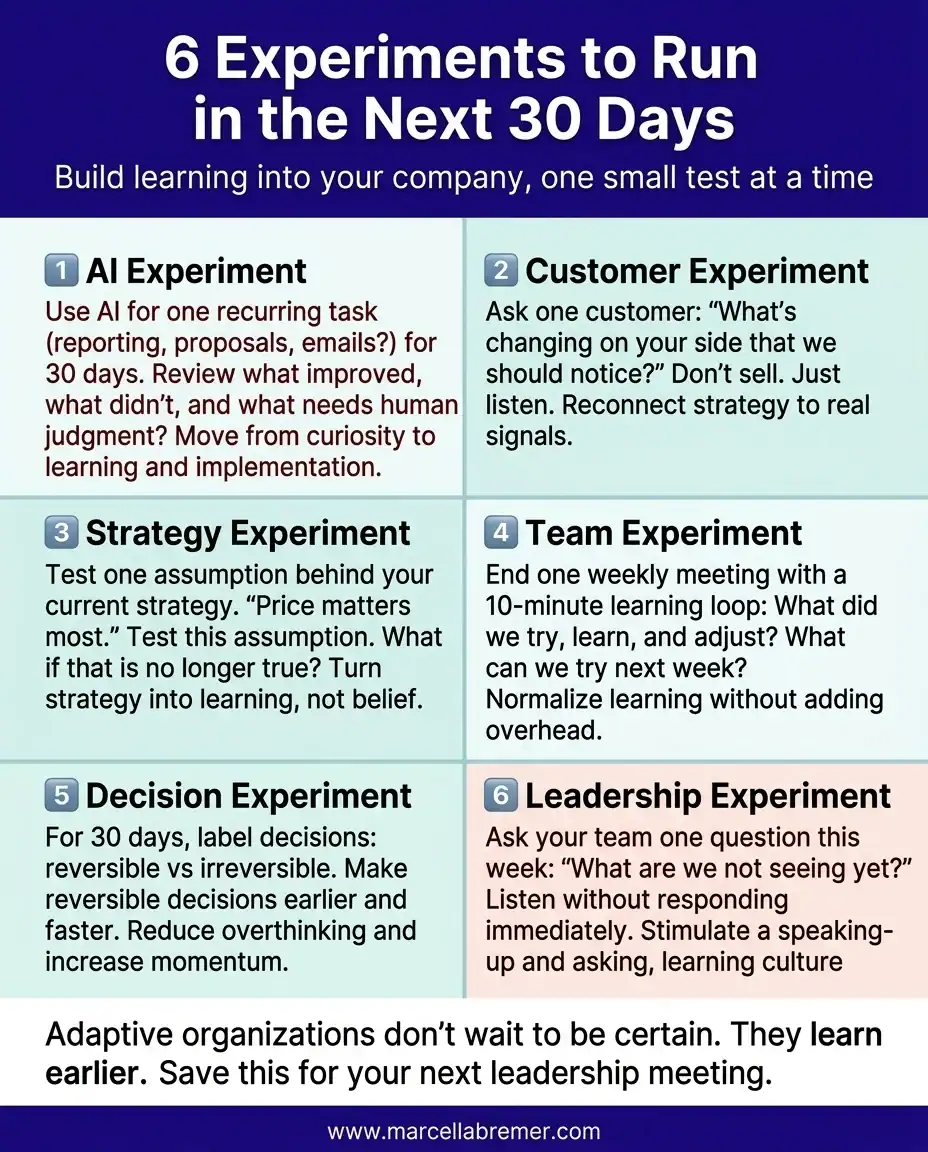
That’s the core idea. Lower the stakes. Increase trust. Learn what works and what doesn’t work – based on the results you get. Here are six experiments your leadership team can try in the next 30 days.
One AI workflow
Pick one recurring task: reporting, proposals, internal communication, customer responses? Use AI for that task for 30 days. At the end, review together: what improved? What didn’t? Where did human judgment still matter most?
The purpose is to move from curiosity to learning. Most teams talk about AI without testing it in a sustained way. Thirty days is enough to learn something useful, and short enough to feel safe.
One customer conversation
Pick one customer you haven’t spoken to in a while. Call them. Ask one question: “What’s changing on your side that we should be paying attention to?”
Don’t sell. Just listen.
The purpose is to reconnect your strategy to real signals. Strategies drift when they lose contact with the people they’re designed to serve. One honest conversation can surface what no internal meeting will.
Test one strategic assumption
Write down one assumption that sits beneath your current strategy. “Our customers won’t adopt AI quickly.” “Price matters most in our market.” “This segment will stay stable.”
Now, design a small test to challenge it. Talk to five customers. Run a pilot. Gather data that either confirms or questions the assumption.
The purpose is to turn strategy into learning instead of belief. Outdated assumptions are an organizational risk. The ones you don’t test are the ones that blindside you.
A 10-minute learning loop
At the end of one weekly meeting, add four questions. “What did we try this week? What worked? What didn’t? What will we try next?” Keep it to 10 minutes. No preparation needed.
The purpose is to normalize learning without adding overhead. As one reader observed, the real shift happens in month three or four, when the team starts asking “what should we test next?” without being prompted. That’s when learning loops become culture.
Reversible decisions first
For 30 days, label every decision your team faces as either reversible or hard to reverse. Then make the reversible ones faster. Don’t schedule another meeting for a decision you can undo next week.
The purpose is to reduce overthinking and increase momentum. Most teams treat every decision as if it’s permanent. Separating the two categories frees up energy for the decisions that genuinely need careful thought.
Ask what you’re not seeing
Ask your team one question this week: “What are we not seeing yet?”
Then listen without responding immediately. Don’t explain, defend, or redirect. Let the answers sit.
The purpose is to build a culture of speaking up and learning. This experiment is the simplest on the list. It’s also the hardest, because the quality of the answers depends entirely on how safe it feels to give them.
Small experiments build an adaptive company
None of these experiments requires budget approval, restructuring, or a consultant. They require 30 days and the willingness to learn from what happens.
One reader put it well: “When leaders frame things as experiments rather than initiatives, it changes the energy in the room. It lowers the stakes just enough for people to be honest about what’s working and what isn’t.”
That shift from “initiative” to “experiment” is more than language. Initiatives carry expectations of success. Experiments carry permission to learn. Organizations that talk about adaptability but never experiment are trying to build a muscle they never use. That’s not possible!
Pick one experiment. Run it for 30 days. Then ask your team: what did we learn, and what should we test next?
© Marcella Bremer, 2026