Most leaders think adaptation is a speed problem. Move faster. Decide quicker. Ship sooner.
But what if the real problem isn’t speed? What if it’s attention?
Technology changes exponentially. Organizations change more slowly. That gap is structural, and it doesn’t disappear just because you work harder. But speed isn’t what separates the companies that thrive from the ones that get blindsided.
Attention does.
What the research shows
In a large-scale study of 8,430 companies over five years, Dr. Ian Hallett analyzed the strategic language leadership teams used in their annual reports and how it correlated with sustained profit dominance across industries.
Only a handful of companies achieved and maintained a dominant profit share. What set them apart wasn’t smarter people, better execution, or more resources.
It was where they focused their strategic attention.
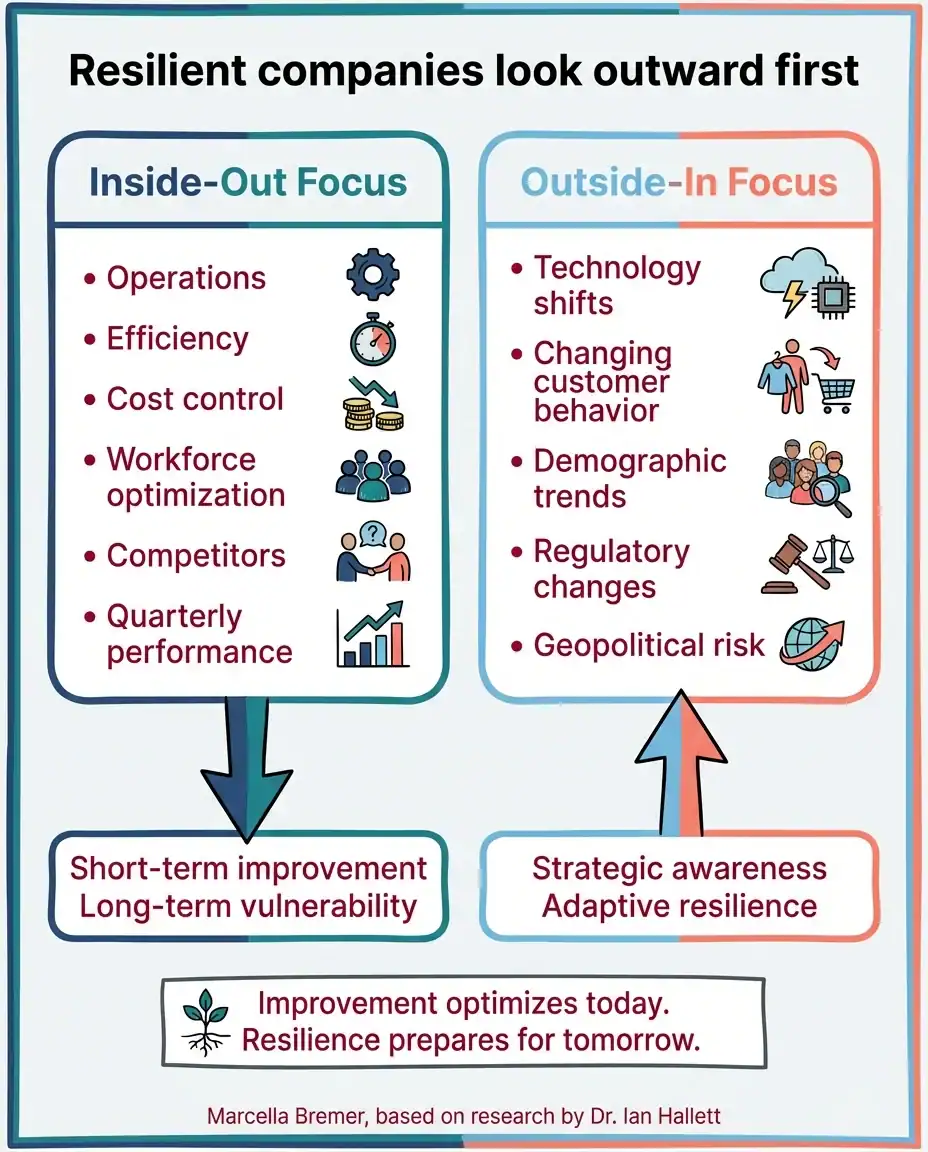
The companies that outperformed consistently wrote about the world, not themselves. They tracked technology adoption curves, shifting customer behavior, demographic transitions, and regulatory and geopolitical shifts. Their strategic language was outward-facing: what is changing, and what are we building in response?
Most other companies focused inward. Operations. Efficiency. Capital allocation. Competitors. Quarterly results. Their language was: “What are we doing, and how well?”
That inward focus isn’t wrong. It’s necessary. But it’s not sufficient.
Competent but fragile
Here’s the trap. Improvement feels productive. When you’re optimizing operations, cutting costs, and hitting quarterly targets, it genuinely feels like progress.
But improvement optimizes a present that’s already becoming the past.
That’s how organizations become competent but fragile. Competent because they execute well against today’s reality. Fragile because they miss the structural shifts that redefine tomorrow.
Think about it this way. If your entire strategic conversation is about how to do what you’re already doing, better and faster, you’ll never surface the question that actually matters: should we still be doing this at all?
I’ve seen this often with clients. Focusing on doing things the right way, instead of asking: Are we doing the right things?
This isn’t just a big-company problem. Small and medium-sized businesses face the same dynamic, often with less margin for error. When a structural shift hits (a technology change, a demographic transition, a regulatory move), the organizations that weren’t paying attention don’t get a second chance to catch up.
The inside-out trap
Most leadership teams default to an inside-out perspective. It’s natural. You know your operations. You control your budgets. You measure your performance. The internal world is tangible and manageable.
The external world is messy, uncertain, and harder to act on. So it gets less airtime.
But the companies in Hallett’s research that sustained dominance did the opposite. They started outside-in. They made external shifts the starting point of strategic conversation, not an afterthought.
They didn’t try to track everything, but they chose which structural changes mattered most to their business and adapted deliberately.
The difference isn’t about gathering more information. It’s about where your attention goes first.
A practical test for your next meeting
You don’t need a new framework to start shifting this. Try this with your leadership team:
Pull your last two or three strategy documents, board presentations, or leadership meeting agendas. Read through them and estimate how much attention goes to external shifts versus internal optimization.
How much space is given to what’s changing in your market, your customer base, your technology landscape, your regulatory environment? And how much goes to operations, efficiency, performance metrics, and competitive positioning?
If most of your strategic thinking is inward-facing, you may be optimizing yesterday’s game.
Then ask one question together: What external force in our industry is getting the least strategic attention right now?
Not the one everyone is already talking about. The one that’s reshaping the ground underneath your current strategy.
That’s the conversation worth having.
Competing against the future
The companies that thrive don’t try to keep up with everything. That’s impossible and exhausting. Instead, they choose which structural changes matter most, and they adapt deliberately, before the pressure becomes urgent.
They compete against the future, not just today’s competitors.
The shift from inside-out to outside-in isn’t a one-time exercise. It’s a habit. A standing question in every strategy conversation: “What has changed out there, and what does that mean for what we’re doing in here?”
Start with one question. One external shift. One honest conversation.
That’s where adaptive resilience begins.
© Marcella Bremer, 2026
If this tension feels familiar inside your leadership team, we’ve created a short Future-Fit Diagnostic to help assess your adaptive capacity. Download it here ↓ https://mlla.nl/futurefit
Research reference: Dr. Ian Hallett’s large-scale analysis of strategic language and sustained profit dominance across industries (8,430 companies, 5-year study).
If you want to check if your strategy is adapted to possible future scenarios, check out our Strategy Sprint for leadership teams at https://www.marcellabremer.com/strategy/