Imagine. You’ve spent weeks updating your strategy for the age of AI. Your team explored multiple scenarios, not just for AI, but also for other future possibilities. What if our supply chain becomes unreliable? What if extreme weather damages our building, and the power grid is unreliable? What if the competition is faster with AI? What if inflation keeps going up? And it is hard to hire and retain the real talents? And our clients demand more personalized service?
It’s all integrated; your strategy is brilliant. You have plan A, but also B, C, D – you know when to switch, you defined actions to take when things move in another direction. You start with the no-regret improvements you can implement right now, which will make your company more adaptive to whatever may happen.
And then – nothing happens. People nod, but they don’t implement the improvements. They say they understand the strategy, but don’t take action. Your culture is keeping your company stuck in the past.
Or, the other way around. Your culture values learning and experimenting, and several teams are using AI tools to see what is possible. But those hobby experiments sap time and energy, and go in all directions.
There’s no strategic focus behind it, and it’s causing friction between teams and within the leadership team. Who gets the budget to do what? Why is your team making my team wait for the usual output? Shouldn’t you focus on production instead of playing around, even though you call it learning & innovation?
Or, another scenario: both the strategy and the culture seem aligned for AI. You’ve identified how AI can disrupt your business model, and you’ve decided on how to deploy it strategically. Making some big changes to anticipate disruption. Your culture likes to innovate, but AI adoption is lagging.
What’s the matter? Then you get it. They distrust AI. It will take their jobs after it has tapped their knowledge and skills. They resist AI because you focus on technology and not on people first.
Strategy, Culture, and AI
Do you recognize some of these examples? We’ve seen them play out.
Your strategy needs to be adaptive, not an annual ritual that produces a paper tiger.
Your culture needs to be open to learning and safe to innovate and pivot quickly if needed, not focusing on efficient performance alone and avoiding changes at all costs.
Your AI use needs to be strategic, not just making today’s business more efficient, but adding value for possible futures.
Score your SCAI Profile
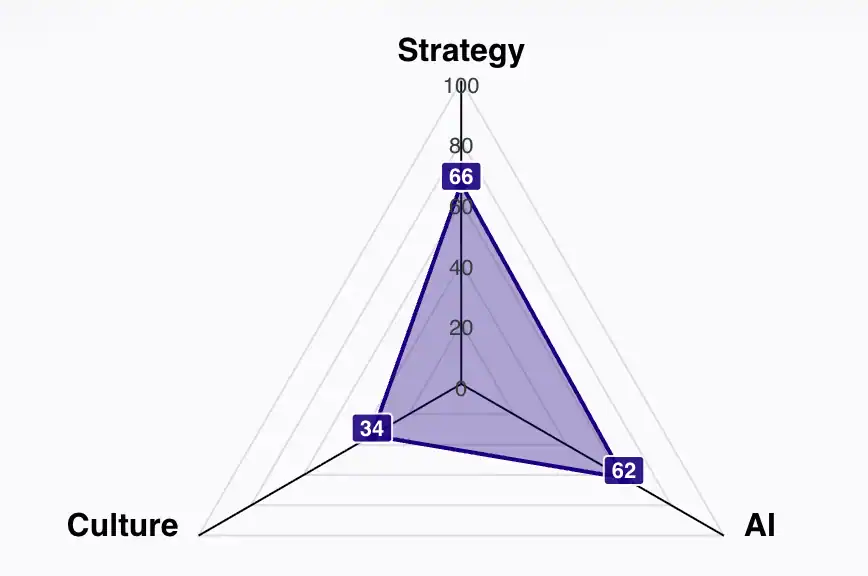
SCAI stands for Strategy, Culture, and AI adaptability. Together, they determine your company’s adaptability (a.k.a. future fitness). And the weakest one limits the other two.
That interaction is what the SCAI Profile measures. The SCAI Profile is a free, 5-minute online assessment that scores your organization across three pillars:
Strategy and Foresight. How regularly does your leadership team revisit its assumptions? Do you scan for signals outside your usual field of view? Do you work with scenarios, or plan for one future and hope it arrives?
Adaptive Culture. Can people say what they really think? Do you learn from failure or punish it? Is experimentation a habit or an exception? Four foundations determine whether your culture helps or hinders adaptation: positive awareness, connection and collaboration, learning and autonomy, shared purpose and meaning.
Strategic AI Readiness. Can your leadership team name specific ways AI could affect your business model? Have you discussed it beyond speed and efficiency? Is your team curious, or fearful?
15 questions. Slider-based. Your results appear immediately as a radar chart showing your score (0-100) on each pillar. The shape of the radar tells the story at a glance.
Score your SCAI Profile assessment here.
SCAI determines adaptability
The SCAI Profile shows the interaction between three forces that are usually treated separately.
- Strong strategy combined with weak culture means plans nobody follows.
- Strong AI adoption combined with a weak culture means tools spread like hobby horses.
- Strong culture without strategic foresight means people collaborate well on business-as-usual while the world moves on.
Think about your SCAI Profile, share it with your team, and take the next step if you want.
The SCAI Debrief is a 45-minute session where we walk through your results together. Use our experience in culture, foresight, and organizational transformation. We help you name what’s behind the numbers and identify the first concrete move.
If you’re ready to close the gap, the SCAI Program offers six guided sessions over three months, customized to your profile outcome.
Take the SCAI Profile
Free. 5 minutes. Immediate results.
See where your organization stands today. The gap your SCAI Profile reveals can be the start of developing adaptability to thrive in an uncertain, AI-accelerated future.
Get Your Free SCAI Profile → here!
© Marcella Bremer, 2026