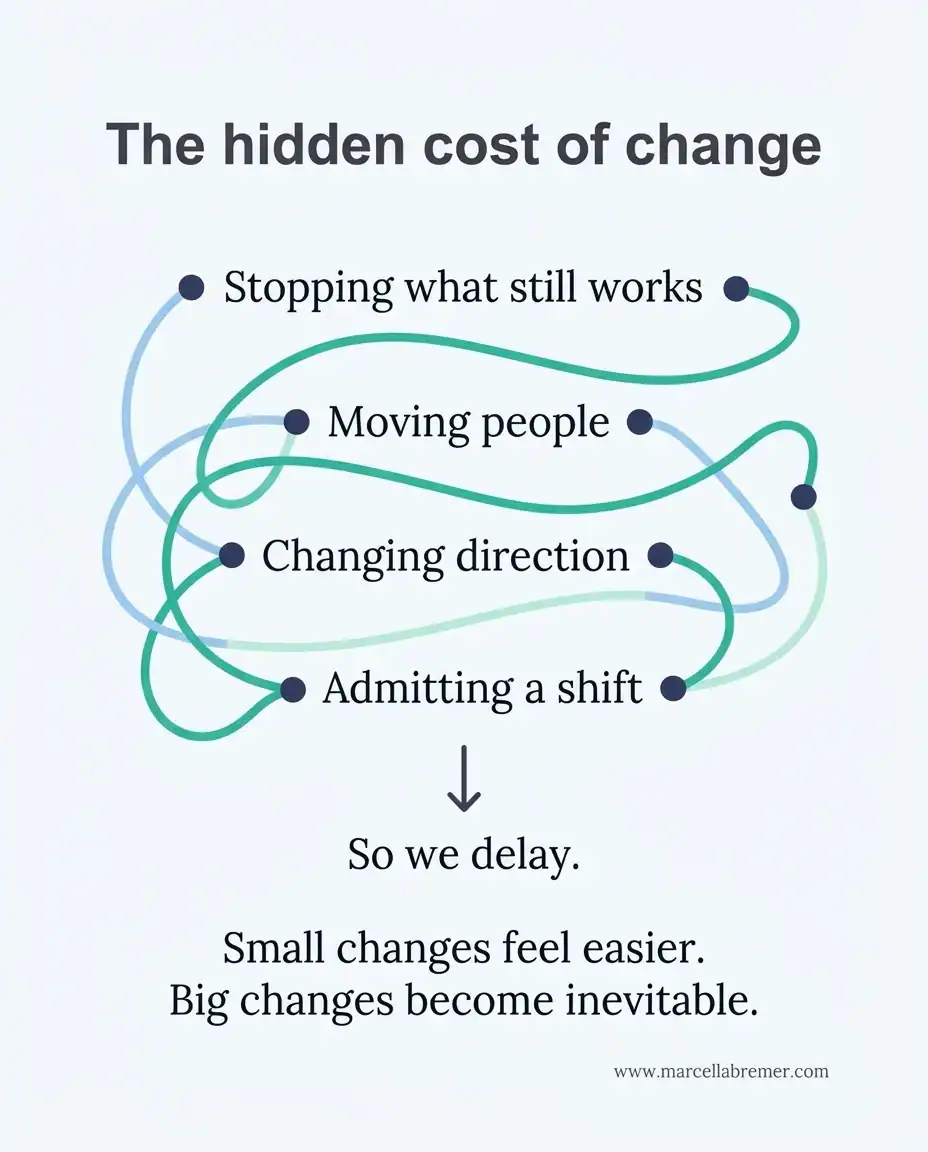
Your strategy isn’t slow because people resist the change itself. It’s slow because changing it has a cost today. While the benefits of the change may show up tomorrow or later.
Every real strategic shift means stopping something that still works (for now). Reallocating people. Admitting a previous decision no longer fits. Using another process that takes time to learn.
Change is not a strategy problem. It’s often a trade-off problem.
And most teams avoid the trade-off. Not because they don’t see the need for change. But the system makes change feel too expensive in the short term.
Why we tweak instead of change
Teams adjust at the edges. Small improvements. Local optimizations. We fiddle with incremental changes, but the core stays the same.
Everyone senses it. The strategy discussions keep circling the same topics. The real conversation, about what to stop, doesn’t happen. Because saying it out loud makes it real. The next conversation, about why people agree on the change but don’t act on it, doesn’t happen either. Especially when you’re busy (and everyone is!).
When I posted this observation on LinkedIn, one response captured the dynamic: “The real barrier isn’t resistance. It’s the short-term pain of letting go of something that’s still working.”
That’s sunk cost bias at the organizational level. The feeling: “We’ve been building this; it took so much effort, so let’s keep going.” Even when the direction no longer fits.
That’s running on autopilot, the business-as-usual bias: the assumption that current conditions will remain roughly the same. That’s why you tweak your work a bit, and you keep running to meet your performance indicators.
The authority problem
There’s a layer beneath today’s cost of change that often goes unexamined. Stopping something that still works, reallocating people: each of those decisions requires someone with a clear mandate to absorb the cost.
When that mandate is unclear or unassigned, change feels unauthorized, or scary at least. People become cautious and follow the system’s tendency to preserve the status quo.
One reader noted: when authority is unclear, the system defaults to preserving the status quo. That’s not resistance. That’s a structural gap.
The certainty pitfall
The other pattern that makes a change expensive: waiting for perfect information before acting. Many organizations delay not because change is costly, but because they wait for certainty that never arrives.
In stable industries, that patience used to pay off. You could research, analyze, and plan with reasonable confidence. In a complex, interconnected, AI-accelerated world, that approach breaks down. By the time the data is complete, the window of opportunity has moved. By then, the cost of change may be impossible to bear.
Adaptive organizations accept imperfect information earlier. They make decisions with enough data, not all the data. That willingness to act under uncertainty is what separates companies that adapt from companies that react too late.
Make change cheap
Adaptive companies operate differently. They make small changes cheap, so they don’t need big, painful ones later.
That means designing systems where experimentation is normal, where stopping something doesn’t require a restructuring, where redirecting resources is a regular conversation instead of a crisis.
A regular review where teams identify one thing to stop, even if it still works, can shift the culture over time. It normalizes the conversation. It makes the cost of small changes lower than the cost of one big delayed pivot.
As someone summarized: “Strategy stalls when the cost of change is higher than the cost of staying the same, even when everyone knows the direction is wrong. Make change cheap, or pay for it later.”
What should stop?
The question most teams avoid in a room together isn’t “where should we go?” It’s “what should we stop?”
Not because they don’t have an answer. Because saying it out loud means something has to happen. It means a trade-off becomes visible, and someone has to own it.
- What are you continuing because changing it feels too expensive in the short run?
- What would it look like to put this direct cost of change on the table and brainstorm solutions to make the change work? That way, you can reap the benefits of timely strategic change tomorrow.
© Marcella Bremer, 2026
How future-fit is your company? Check your Strategy, Culture & AI readiness (SCAI).