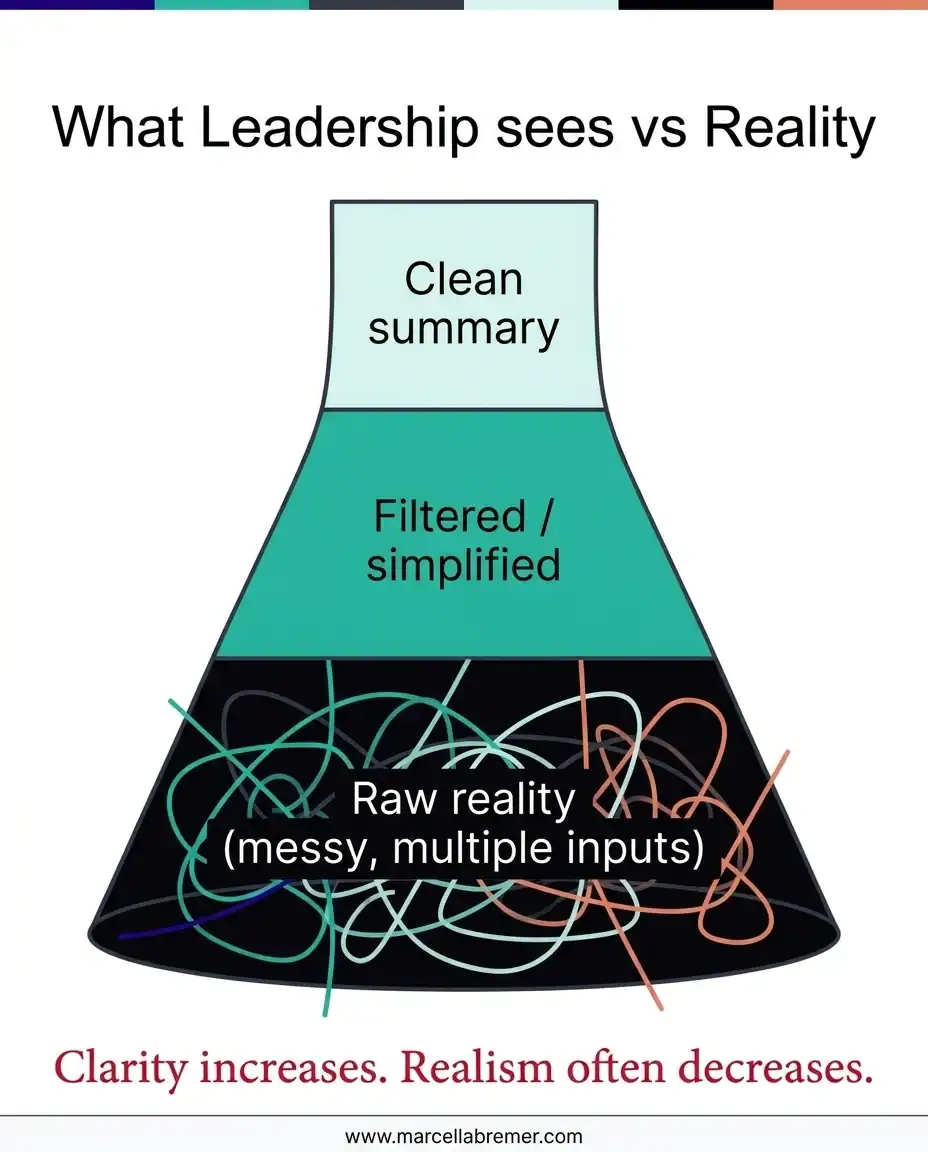
Most leaders think they need more information. They don’t. They need less filtered information. The problem isn’t data. It’s what happens to it on the way up.
By the time information reaches a leadership team, it’s been simplified, softened, and made presentable. Uncertainty disappears. Tension gets removed. Concerns become “manageable updates.”
This doesn’t happen because people hide things. It’s because the system rewards clarity over reality.
How reality gets cleaned up
Leaders make decisions based on clean summaries and stable narratives. While the real situation is messier. And moving faster. Do you recognize it?
This isn’t a visibility problem. It’s a distortion problem. Each person in the chain filters for the person above. Stack three or four layers, and what reaches leadership has been optimized for clarity, and it looks better than reality. The tension, the uncertainty, the signals that matter most, are removed.
One reader described the dynamic as a feedback loop: leadership receives clean information, makes confident decisions, and reinforces the signal that clean information is what’s valued. Each cycle trains the organization to smooth out reality a little more. Over time, the gap between the dashboard and the ground floor widens, without anyone making a deliberate choice to widen it.
Nobody decided to distort the information. The system trained itself.
A culture question
This is where information distortion becomes a culture question.
If your organization rewards clarity, certainty, and actionable updates, people will deliver exactly that. They’ll clean up the ambiguity before it reaches you. Not out of deception, but out of self-preservation.
One commenter shared a useful diagnostic: in your last five meetings, when did someone bring genuine ambiguity? Not a problem with a solution, but real uncertainty with no clean answer. If that rarely happens, your system has been trained for distortion. It smooths raw information into a glossy front.
The fix isn’t asking for more honesty. It’s rewarding the people who bring the uncomfortable version, not just the actionable one. That’s a culture shift. It requires leaders who can sit with uncertainty without immediately demanding a plan. And it requires leaders who can create a safe space, a culture where it is okay and valued to share genuine questions, ambiguities, and uncertainties, and to explore these messy issues together.
Another reader commented: “I created time during meetings to hear what people might otherwise soften before sharing. It feels uncomfortable at first, but it creates real trust and much sharper choices.”
A way to make it feel safer is to use a “role” for this. During the meeting (or just for one topic), assign one person or the whole team the role of The Glossy Detector. Let’s probe and nudge the glossy appearance of a plan with genuine questions. Celebrate the discomfort these questions evoke and explore the topic further (or schedule a follow-up meeting for this).
- Is this really as clear as it looks?
- What happens if things don’t go as proposed in this plan?
- Are we sure that we gathered different perspectives from all stakeholders?
- Did we test the assumptions hidden in this presentation?
- Could the opposite be true?
- (etc.)
Reduce the distance
Adaptive organizations don’t just improve reporting. They reduce the distance between what’s happening and what leadership hears.
That means fewer layers of translation. More direct contact with the front line. Regular moments where leaders hear the unfiltered version, not the presentation-ready one.
Some practical approaches: skip-level conversations where leaders talk directly with teams two or three levels down. Walking the floor, not as a performance, but as a habit. Inviting people to share what’s uncertain, not just what’s resolved. Asking “What are we not seeing?” and making it safe to answer with “I don’t know yet, but here’s what worries me.”
The leaders who do this well aren’t just gathering better data. They’re signaling that messy, incomplete, uncertain information is welcome. That signal changes what flows upward.
What are you not hearing?
- Where might reality be getting simplified before it reaches you?
- What decisions are you making based on clean summaries that may not reflect what’s happening on the ground?
The distortion isn’t visible from the top. That’s what makes it dangerous. The only way to find it is to go looking and to make it safe for others to show you.
© Marcella Bremer, 2026
How future-fit is your company? Check your Strategy, Culture & AI readiness (SCAI).