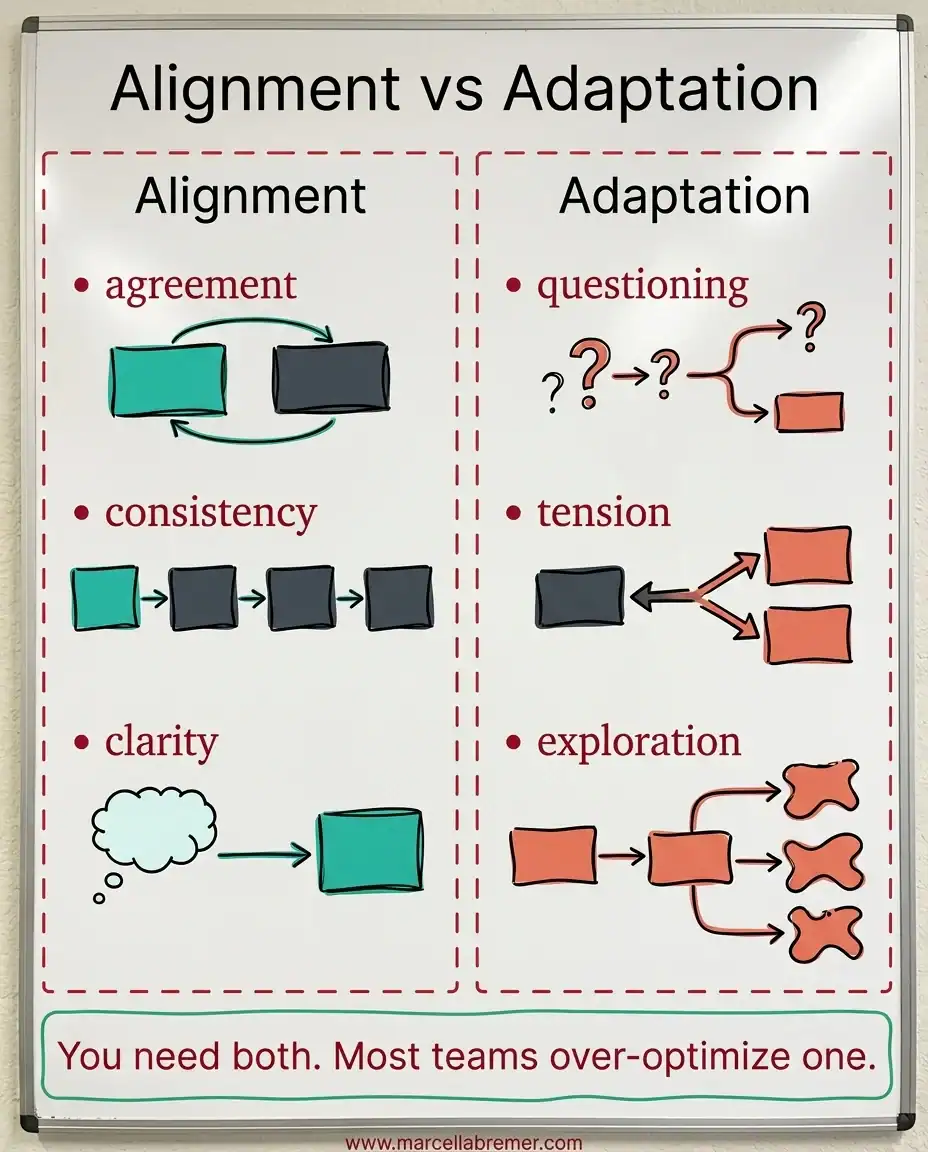
Alignment can kill adaptation. Many leadership teams want more of it. More agreement. More consistency. More clarity. It feels like progress. But too much alignment creates something else: silence.
Because when everyone is aligned, fewer questions get asked, fewer doubts get raised, fewer alternatives get explored. Not because people don’t see them. Because they don’t feel necessary anymore.
Is Alignment becoming a norm?
The nodding, the consistency, the shared language: it looks healthy. But what it can signal is that the conditions for honest dissent have quietly disappeared, and nobody noticed because everything still looked smooth.
As one senior leader commented when I posted on LinkedIn: “Alignment rarely kills adaptation on its own. What does is the removal of friction that would have revealed missing assumptions earlier.”
That distinction matters. The problem isn’t alignment itself. It’s when teams optimize for agreement, they lose the friction that tests assumptions, surfaces blind spots, and catches weak signals early.
And those unspoken differences don’t disappear. They move into private judgment calls later in the process, when it’s harder to course-correct.
Fruitful tensions disappear
Most leadership teams aren’t poorly aligned. They’ve designed out the conditions for visible disagreement. No structured channel for challenge. No protected moment where a different view is expected rather than tolerated. No space where someone can say “I see this differently” without it feeling like they’re slowing things down.
One reader put it sharply: “Alignment is risky when it starts protecting the plan from reality. Teams can become so committed to shared direction that dissenting views and uncomfortable data arrive too late.”
That’s the pattern. Alignment starts as a strength and becomes a shield over time. The team agrees on a direction, and the agreement itself makes it harder to revisit. Even when the context has changed. Even when someone in the room sees it.
Explore tensions before deciding
Constructive misalignment doesn’t happen by intention alone. You can’t just tell people to disagree more. It has to be built into how decisions get made. A few approaches that work.
- Before finalizing a decision, ask the team: “What could make this wrong?” Not as a ritual, but as a genuine question with space for genuine answers.
- Assign someone the role of surfacing the alternative view. Not a devil’s advocate performance, but a real responsibility to ask: “What are we not seeing? What assumption are we protecting?”
- Separate the moment of exploration from the moment of decision. When teams explore and decide in the same conversation, alignment pressure wins. Give the exploration room to breathe before narrowing down to a decision.
- Pay attention to the pattern after decisions are made. If implementation keeps stalling, or if the same issues resurface in different forms, it’s often a sign that alignment was performed, not real.
Design for both tension and alignment
Alignment creates clarity. Tension creates learning. You need both. Most teams over-optimize one.
The healthiest teams are where people feel safe enough to challenge ideas without feeling like they’re threatening the relationship or the team. Where disagreement is treated as a contribution, not a disruption.
Adaptive organizations don’t aim for perfect alignment. They create space for constructive misalignment, where different views are explored before decisions are made.
Where might your team be too aligned to notice what’s changing?
What would happen if you built a moment of structured disagreement into your next important decision?
PS: How adaptive is your company? Score your SCAI Profile in 5 minutes → https://mlla.nl/scai-mb
© Marcella Bremer, 2026