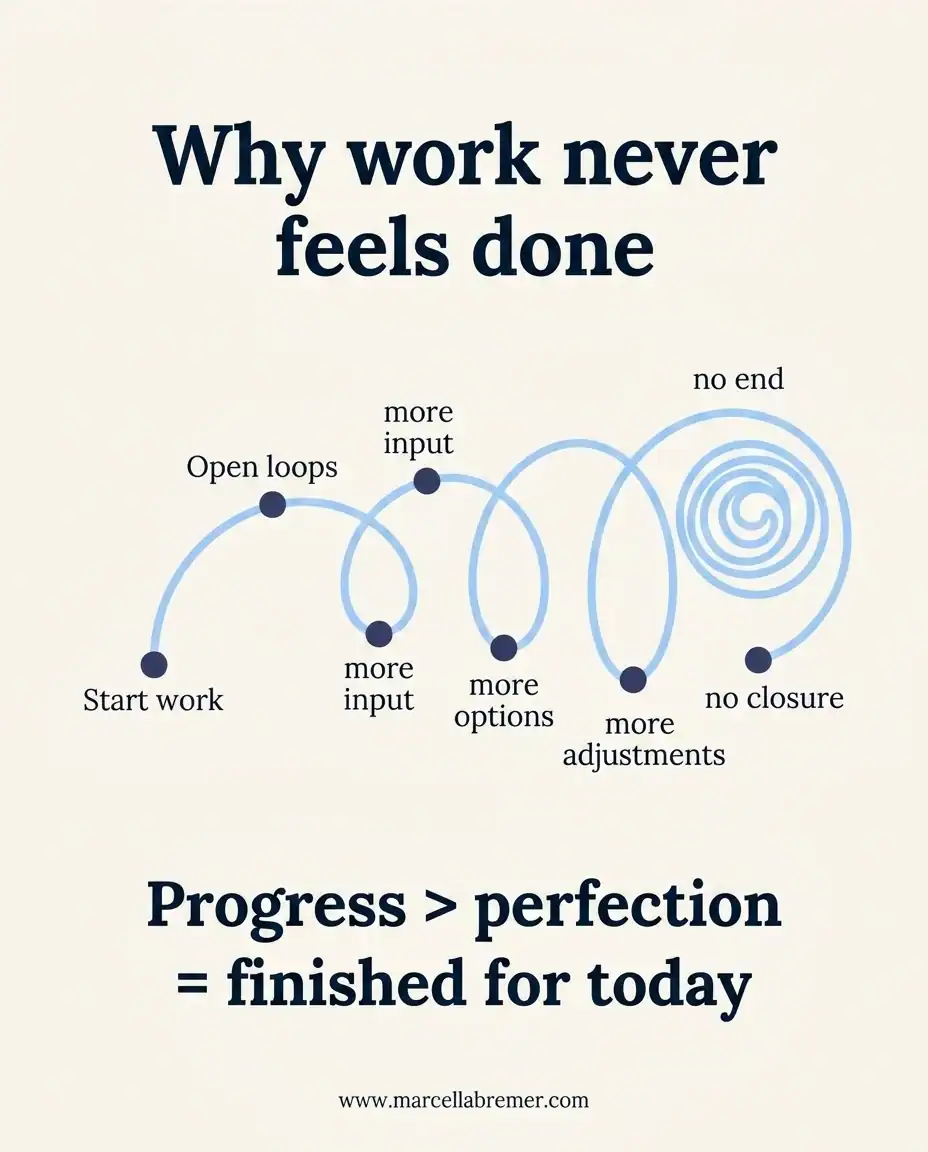
Work doesn’t feel “finished” anymore. There’s always more input possible, other angles to consider, changes that demand updates. The world has become more fluid. More options. More interdependencies. More moving parts. So closure becomes rare.
I notice it in myself. Tasks done. But no real sense of: “This is complete, and I can relax.”
And that matters more than it seems. Because that feeling of completion is what creates mental rest. Without it, work keeps running in the background. Your radar stays on, sensing possible adjustments as the world keeps evolving. Even when your task seems finished, or your workday is over.
Create closure to stay sane
Constantly refining and adding inputs keeps the brain in working mode, even after the task is done. The result isn’t better work. It’s chronic mental fatigue. And fatigue makes everything harder: decisions, collaboration, creativity, adaptation.
The challenge isn’t just keeping up and getting things done. It’s learning to create closure in a world that never stops moving.
Shared definition of “done and good enough”
When a team has no shared definition of “done,” each person carries their own version of “is this finished?” That creates invisible misalignment. One person moves on, another keeps refining, a third reopens the discussion.
This isn’t just frustrating. It’s expensive. Teams waste energy revisiting decisions that were supposed to be made. Plans keep shifting because nobody agreed on when “good enough” had been reached. Progress stalls, not because people aren’t working, but because they keep refining.
Defining “done” together, before the work starts, is a coordination tool as much as a personal one. It aligns expectations, protects energy, and frees the team to move forward.
The information trap
One pattern that keeps work loops open: the belief that more information leads to better decisions. Sometimes it does. But often, gathering more input just creates more open loops without improving the outcome.
There’s a point where additional information stops being useful and starts being a way to avoid deciding. We keep researching, consulting, refining, because deciding feels risky and refining feels productive. But the cost of delaying a decision is often higher than the cost of making an imperfect one.
Leaders who define how much input is enough before the process starts protect their teams from this trap.
Small practices that help
Creating closure in an open system takes intentional effort. A few things that help, for individuals and teams:
- Define “done” before you start. Not after. Not during. Before. What does finished look like for this task, this project, this meeting? When a team agrees on this upfront, it changes how they work and when they stop.
- Limit how many inputs you allow. Not every perspective needs to be included. Not every data point improves the decision. Set a boundary: three sources, two rounds of feedback, one deadline. Then decide.
- Decide instead of refine. At some point, good enough for now is the right standard. Especially for reversible decisions. You can adjust later. But you can’t get back the energy you spent endlessly polishing.
- Live by “progress over perfection”. Your plans, tasks, and workdays are not perfect. But they can be finished for today. And that distinction, between perfect and finished, is where mental rest begins.
Closure as leadership practice
One reader on LinkedIn shared a practice worth adopting: consciously acknowledging and celebrating completion, even if it’s one step on the way to something else. Not as a ritual. As a habit. “This part is done. We’re moving on.”
In a world of constant input and continuous change, the ability to close loops is not a productivity technique. It’s a leadership practice. Leaders who help their teams experience closure regularly and deliberately protect the energy their people need for what comes next.
The companies that adapt best know when to stop, rest, and start fresh.
What would change if your team defined “done” before starting the next project?
© Marcella Bremer, 2026