Nobody scores high on Strategy, Culture, and AI Readiness. That’s the pattern we’ve seen since launching the SCAI Profile.
The SCAI assessment measures how Strategy, Culture, and AI Readiness interact inside organizations. So far, not one company scores high across all three pillars. Most companies have one pillar clearly lagging behind, dragging down the other two.
Most companies are not adaptive enough, but still rooted in yesterday, with a culture that values conformity and efficiency (not learning and change). They revise their strategy once a year and show no strategic AI adoption.
That’s not surprising. What is surprising is how invisible the pattern often is to the leadership team itself.
Two real SCAI profiles
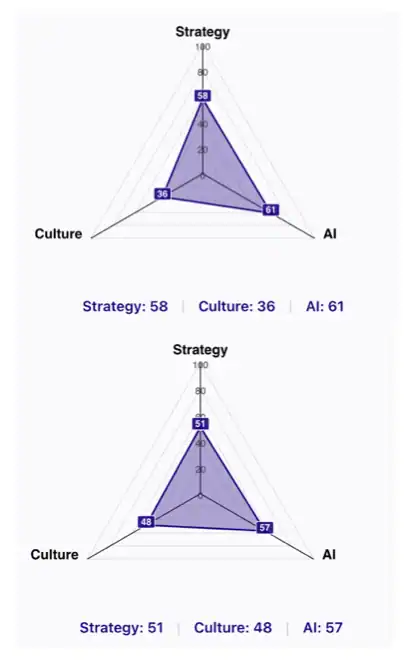
Look at these two anonymized profiles from actual SCAI respondents.
Company A scores 58 on Strategy, 36 on Culture, 61 on AI Readiness.
Company B scores 51 on Strategy, 48 on Culture, 57 on AI Readiness.
At first glance, Company A looks like the one with the bigger problem. Culture scores 36. That’s a visible constraint. Strategy and AI capability are there, but adoption stalls because people can’t absorb change fast enough. The organization has ideas and tools, but the environment doesn’t support learning, experimentation, or honest conversation. Everything gets stuck at the implementation stage.
Company B looks more balanced. No dramatic weak spot. But that balance is deceptive. Everything sits around 50. There’s no clear starting point, and that may diminish the urgency they feel. It’s all mediocre, and thus not well prepared for adaptability to what the future may bring.
How quickly can Company B’s strategy pivot when markets are disrupted, when client needs change, when supply chains become too expensive or unreliable? How well does their culture learn, pilot new approaches, and adapt? How quickly do they embrace strategic AI that changes their organization, so that they bring new products and services to the market?
The SCAI Profile has strategic implications. Company A knows where to start. Fix the culture bottleneck, and the other two pillars can begin to deliver. Company B has a harder challenge. When nothing feels broken, nothing feels urgent. That’s how companies slowly fade out of relevance without ever noticing a single crisis.
The shape tells the story
The shape of the radar matters more than the numbers themselves.
A lopsided profile with one low pillar tells you: this is your constraint. Everything you invest in the other pillars gets limited by the weakest one. Strong strategy combined with weak culture means plans nobody follows. Strong AI readiness combined with weak culture means tools that spread as hobby projects without strategic direction.
A flat, mediocre profile tells you something different: you’re not failing at anything specific, but you’re not building adaptive capacity either. The risk is complacency. When everything scores around 50, leadership teams tend to say “we’re doing okay” when the honest assessment is “we’re equally unprepared across the board.”
Both patterns require action. But the action is very different.
How Strategy, Culture, and AI interact
Most assessments measure one thing. Culture surveys measure culture. AI readiness scans measure technology adoption. Strategy reviews measure strategic clarity.
The SCAI Profile measures how these three forces interact. That’s the real insight. A leadership team that scores high on strategic foresight but low on culture will develop plans that never get implemented. A team with a strong learning culture but no strategic direction will experiment without focus. A team that adopts AI tools without strategic integration will automate the wrong things.
The weakest pillar doesn’t just score low. It actively limits what the other two can deliver. That’s the pattern we keep seeing.
Check the SCAI of your company
Most leadership teams sense that something is holding them back. They feel the friction. But they often can’t name it precisely because the constraint lives in the interaction between pillars, not in any single one.
That’s what the SCAI Profile makes visible. Five minutes to see the shape. The shape tells you where to focus, what’s limiting what, and why effort in one area might not be producing results.
Whether your radar shows a visible constraint or a balanced score of mediocrity, the starting point is the same: look at the pattern, not the individual scores.
Score your SCAI Profile in 5 minutes → https://mlla.nl/scai-mb
© Marcella Bremer, 2026